 Course · 17 lessons · 7 hr 38 min
Deep Learning Course
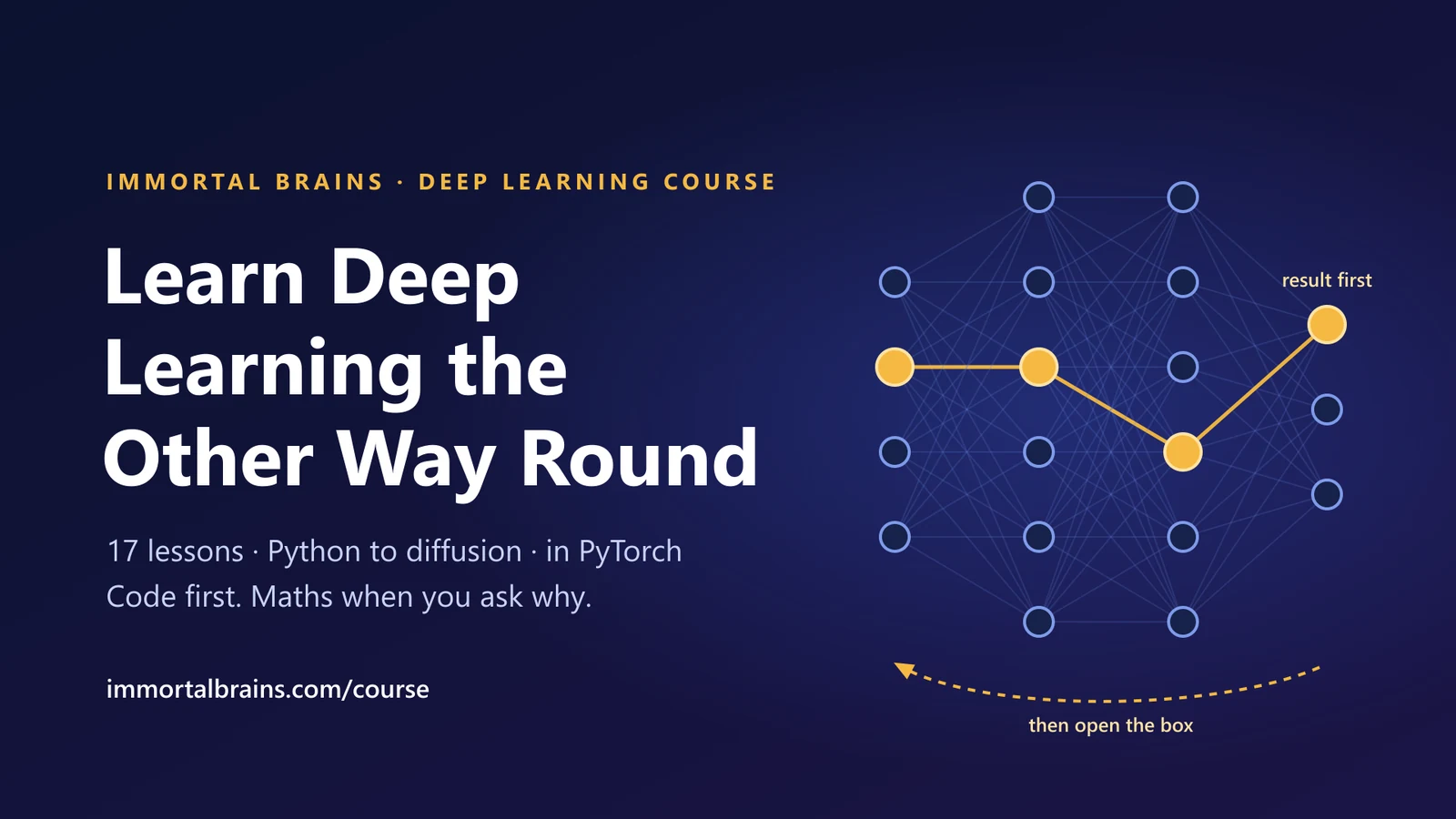
Seventeen lessons, from Python to diffusion models, taught top-down: every lesson starts with a working result in a few lines of code, then opens the box, and the mathematics arrives as answers to the questions the result raises.
Start the course →- Lesson 0 32 min
Essential Python for Machine Learning
The Python you need for machine learning: pythonic idioms, lists, sets and dictionaries, mutability, everyday statements, and the NumPy and Pandas foundations every deep learning project is built on.
- Lesson 1 17 min
Your First Deep Learning Model
Train a 37-breed pet classifier in minutes with transfer learning, then see what goes in and what comes out: tensors, logits, softmax, and what makes a list of numbers a probability distribution.
- Lesson 2 23 min
Pretrained Text Models and the Geometry of Meaning
Sentiment, text generation and semantic search with Hugging Face, then how meaning becomes geometry: vectors, lengths, the dot product derived from the law of cosines, projections and cosine similarity.
- Lesson 3 25 min
Exploratory Data Analysis and the Statistics Behind It
Find and fix the problems in a dataset with Pandas, and the statistics that come with it: why variance squares and divides by n − 1, probability densities, the normal curve, correlation as an angle, and why scaling speeds up training.
- Lesson 4 22 min
Is My Model Any Good?
Why 96% accuracy can mean almost nothing: confusion matrices, precision, recall, F1, ROC and AUC, where cross-entropy comes from (likelihood and the Bernoulli distribution), and the binomial error bars on a test score.
- Lesson 5 25 min
PyTorch Fundamentals, and What a Matrix Really Is
Tensors, Datasets, DataLoaders, nn.Module, autograd and the GPU, written out by hand, and the matrix ideas underneath: matrices as functions, why multiplication goes row by column, and why mini-batches work.
- Lesson 6 23 min
Inside a Neural Network
From the perceptron to multi-layer networks: the geometry of a neuron, a proof that one neuron can't learn XOR, why depth needs non-linearity, universal approximation, and choosing initial weights from variances.
- Lesson 7 49 min
How Networks Learn: Gradient Descent and Backpropagation
Train a network in four lines, then open the box with a ladder of questions: tangent lines, limits and ε-δ, continuity, Taylor's theorem and the learning-rate limit, gradients, convexity and the chain rule.
- Lesson 8 30 min
Training Well: Regularisation, Learning Rates and Tuning
Why networks memorise and how to stop it: the bias-variance decomposition, weight decay as a Gaussian prior, why L1 gives zeros, dropout, early stopping, learning-rate schedules and random search.
- Lesson 9 32 min
Convolutional Neural Networks for Computer Vision
How CNNs see: convolution as a matrix with shared weights, translation equivariance, the output-size formula, receptive fields measured with autograd, and why skip connections keep deep networks trainable.
- Lesson 10 27 min
Recurrent Neural Networks for Sequences
Recurrent networks for sequences in PyTorch: the recurrence, backpropagation through time, and eigenvalues, which explain exactly why gradients vanish or explode, and how the LSTM's additive memory fixes it.
- Lesson 11 28 min
NLP with Deep Learning: Word and Contextual Embeddings
How words become vectors whose geometry captures meaning: co-occurrence, pointwise mutual information, the SVD, word2vec from scratch, why analogies work, and contextual embeddings from BERT.
- Lesson 12 26 min
Attention and Transformers
The transformer built piece by piece in PyTorch: attention as a soft lookup, why we divide by √d_k, attention as an expected value, why order must be added, and sinusoidal positions as rotations.
- Lesson 13 28 min
Working with Large Language Models
How LLMs predict, generate and become assistants, and how to adapt them: the chain rule of probability, perplexity, entropy and temperature, LoRA fine-tuning through matrix rank, and retrieval-augmented generation.
- Lesson 14 29 min
VAEs and GANs for Image Generation
Generating images with VAEs and GANs: multivariate Gaussians, the reparameterisation trick, the KL divergence derived, Jensen's inequality and the ELBO, and the calculus of the GAN's optimal discriminator.
- Lesson 15 25 min
Diffusion Models and Generative AI
Build a diffusion model that turns noise into data, with the maths of why it can jump to any noise level, then step back to generative AI as a whole: Bayes' rule, model families, synthetic data and responsibilities.
- Lesson 16 17 min
Capstone Project
Build and defend a deep learning project of your own: project options, a step-by-step plan, a reusable PyTorch template, an evaluation checklist, and the bootstrap for telling real improvements from luck.